Norway’s power surplus is diminishing over the next 10 years, while European power prices remain volatile.
Predictable, low prices for households are a good thing. The question is how we get there.
If we estimate that Norgespris will cost the Norwegian government roughly NOK 100 billion from its introduction in 2025 and onwards, that would be equivalent to the investment cost of around 20 TWh of new annual onshore wind production, using Pareto Securities’ estimate of NOK 5 per kWh of yearly production.
That is equivalent to around 12.5% of Norway’s current annual power production of approximately 160 TWh.
Simulating 20 TWh of New Wind Power
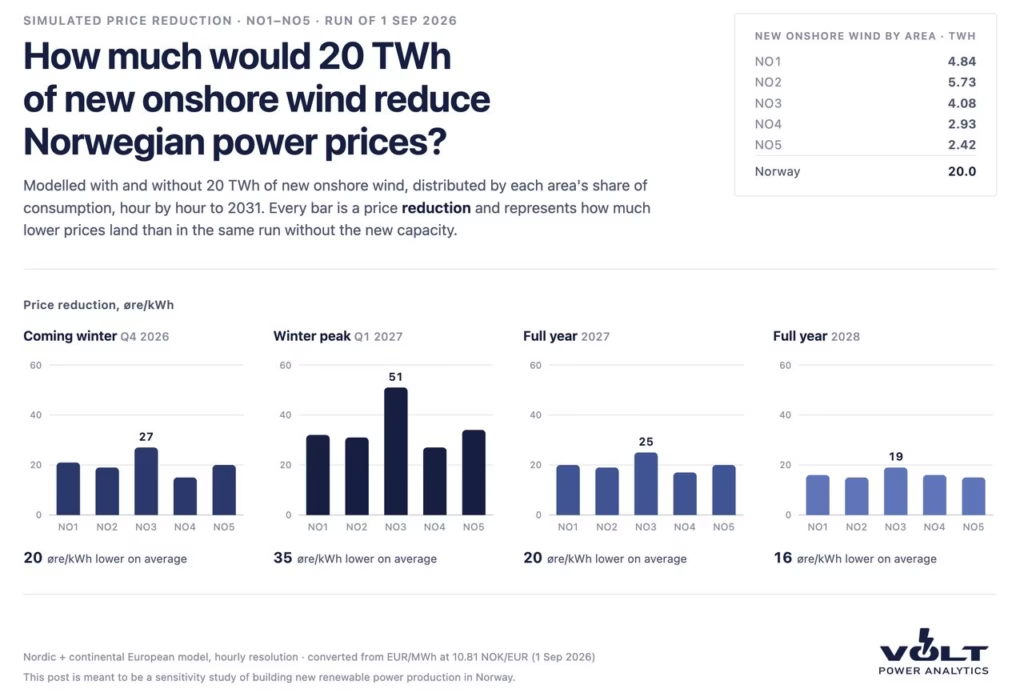
We simulated the Norwegian power market with and without 20 TWh of new wind power production.
The additional generation was distributed across each price area according to its share of consumption and modelled hourly through 2031 across 30 historical weather years from 1991 to 2020.
The results show substantial price dampening across the Norwegian price zones, with the largest impact during winter months.
The Effect Is Strongest in the Near Term
This year, weak hydrology in Southern and Central Norway and elevated gas and coal prices in connected markets push the impact higher.
The effect softens over time as hydrology normalises, fuel prices ease, and electricity consumption grows in Norway and Sweden.
NO3 sees the steepest price reduction as the area becomes more closely coupled to NO4 than to the higher-priced southern price zones.
Price Support or More Power Production?
Norgespris gives private consumers a predictable power price and is one way to reduce household electricity costs.
Building new power production and increasing Norway’s total installed renewable capacity provides a longer-lasting price-dampening effect, while maintaining market mechanisms for efficient consumption patterns.
Disclaimer: This study is intended as a sensitivity analysis of the impact of building new renewable power production in Norway.