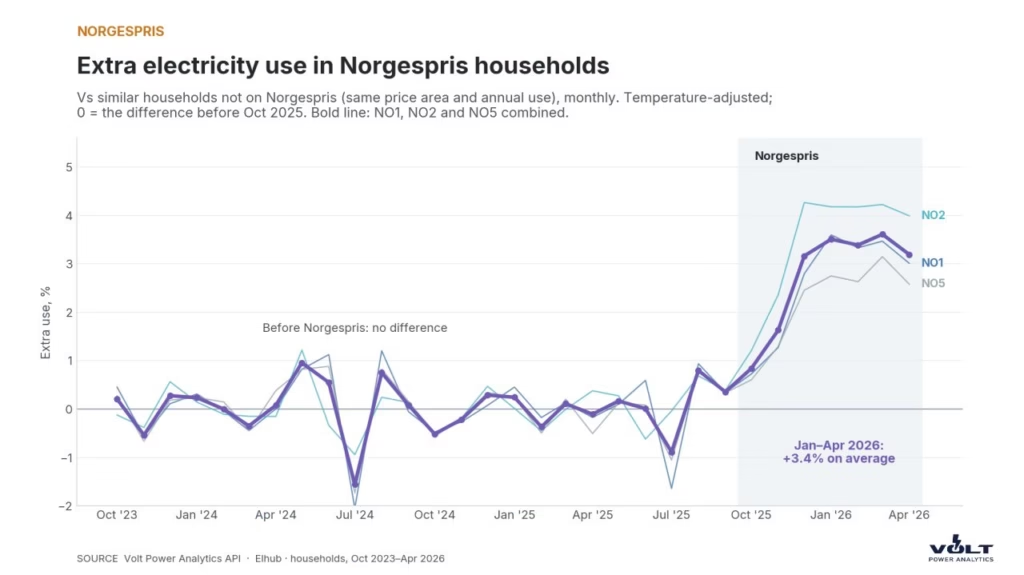
The data suggests that it has.
During NRK Debatten earlier this week, Energy Minister Terje Aasland said that Norgespris has led to few changes in household electricity consumption.
This is possible to test. Elhub has published a dataset that splits hourly household consumption between households that chose Norgespris and those that did not.
We compared consumption among Norgespris households with similarly sized households that did not join, adjusting for temperature, season and weekday.
Norgespris Households Increased Consumption
Before Norgespris was introduced, the two groups moved together for two full winters.
After Norgespris was introduced, households that joined increased their electricity consumption more than households that did not.
From January to April 2026, Norgespris households consumed 3.4% more relative to non-joiners than they did before Norgespris, on average across NO1, NO2 and NO5.
The largest difference was in NO2, at around 4%.
Norgespris Has Also Changed When Electricity Is Used
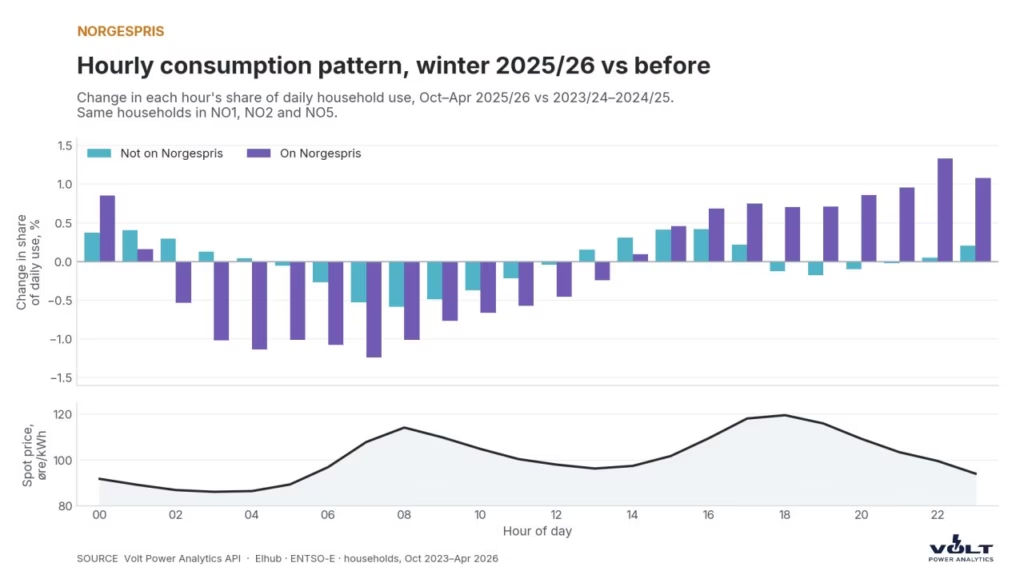
Norgespris appears to have changed not only how much electricity households use, but also when they use it.
Compared with their own consumption pattern before Norgespris, participating households now use relatively less electricity at night and more during the evening.
Non-joiners changed their consumption pattern much less, and their smaller shift was towards cheaper hours.
A Flat Price Changes the Incentive
With a flat electricity price throughout the day, there is no direct incentive to move consumption away from the most expensive hours — the hours when market prices are signalling scarcity.
Next year, Norgespris increases to 45 øre/kWh, while the 2027 forward price is currently around 85 øre/kWh.
The incentive for participating households to continue using more electricity therefore remains.