It depends.
Ahead of the EU summit earlier in October, Ursula von der Leyen said that one member state pays around €145/MWh, where gas sets the price, while another pays around €70/MWh, where renewables and nuclear do.
We checked the data.
Low-Carbon Power Was Cheaper in Spring
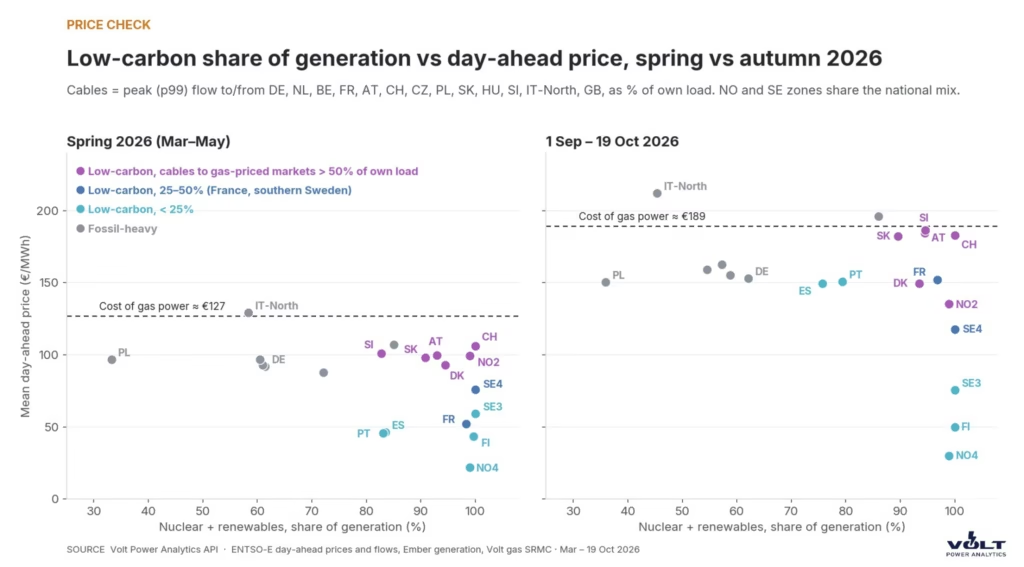
This spring, countries with a low-carbon power mix and weak links to gas-priced markets paid significantly less than the rest of Europe.
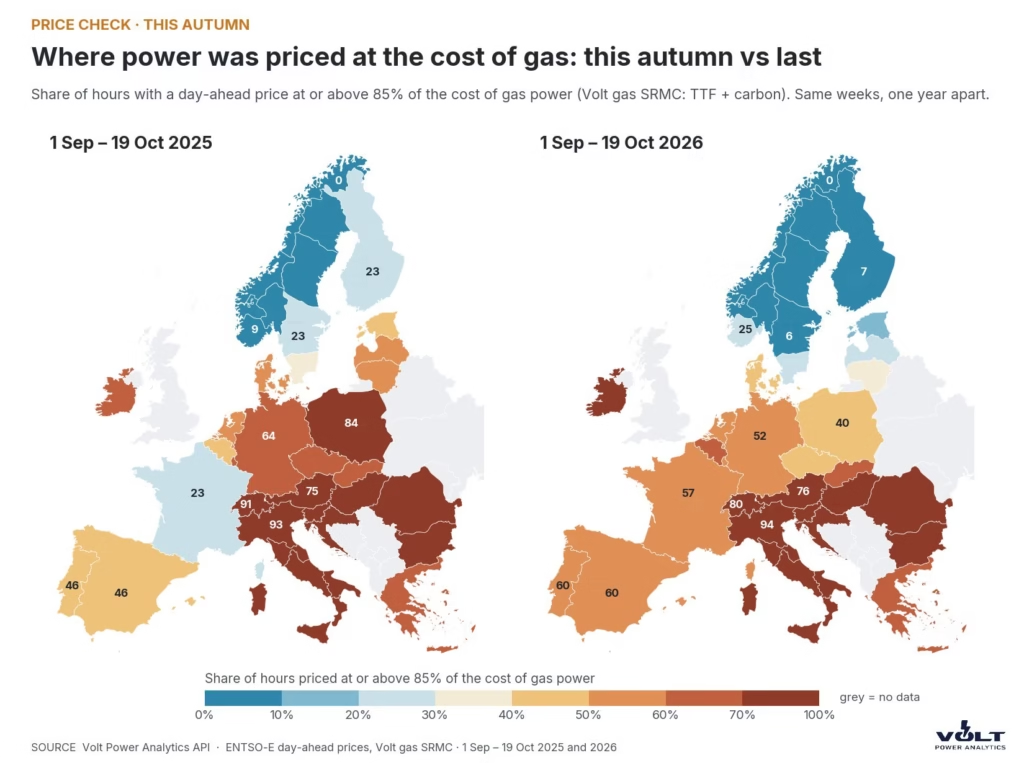
This autumn, however, much of low-carbon Europe has been priced at the cost of gas.
Hydro-heavy and strongly interconnected Austria and Switzerland hit gas-price levels in around 75–80% of hours and averaged approximately €185/MWh, more than Germany at €153/MWh.
Only the more weakly connected Nordic price zones remained cheap.
Why? Water Is Valued Like Gas
Hydro producers price their water based on what it could earn later.
With expensive gas and winter ahead, that value can end up close to the gas price.
Spain and France have both been priced at the cost of gas for a much larger share of hours than last autumn.
Both countries are cheap around midday due to solar generation, but become gas-priced at night when nuclear, wind and hydropower cannot fully cover demand.
France: Less Nuclear, Weaker Wind and Low Reservoirs
France has less nuclear generation and weaker wind output than last year, while reservoir levels are at their lowest in at least a decade.
Its export surplus has fallen from 11 GW to 7.6 GW.
France was priced at the cost of gas in 57% of hours, compared with 23% a year ago.
Spain: Full Reservoirs, but Water Is Being Held Back
Spain’s reservoirs are around 25% above normal, yet hydropower output is lower than last year as producers hold back water.
Spanish hydropower has also been sold at roughly the same price as gas, around €180–185/MWh.
Low Carbon Does Not Automatically Mean Low Prices
A low-carbon power mix only guarantees low prices when generation exceeds what the system can store or export.
So far this autumn, the price of water has largely followed the price of gas.