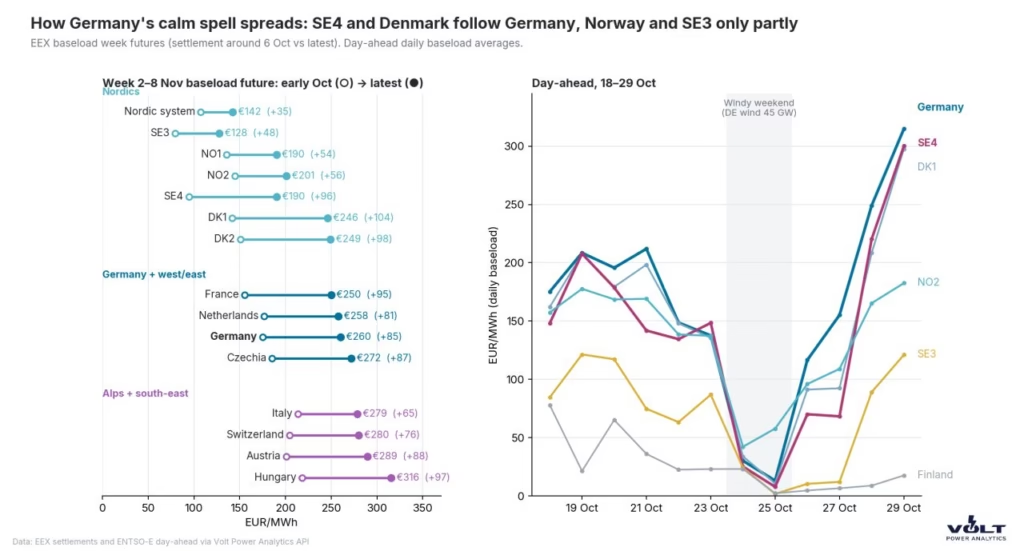
Last Sunday, German spot prices averaged €13/MWh. Today, they are around €315/MWh, while next week’s market is trading at approximately €260/MWh.
Why?
It’s Because of the Weather
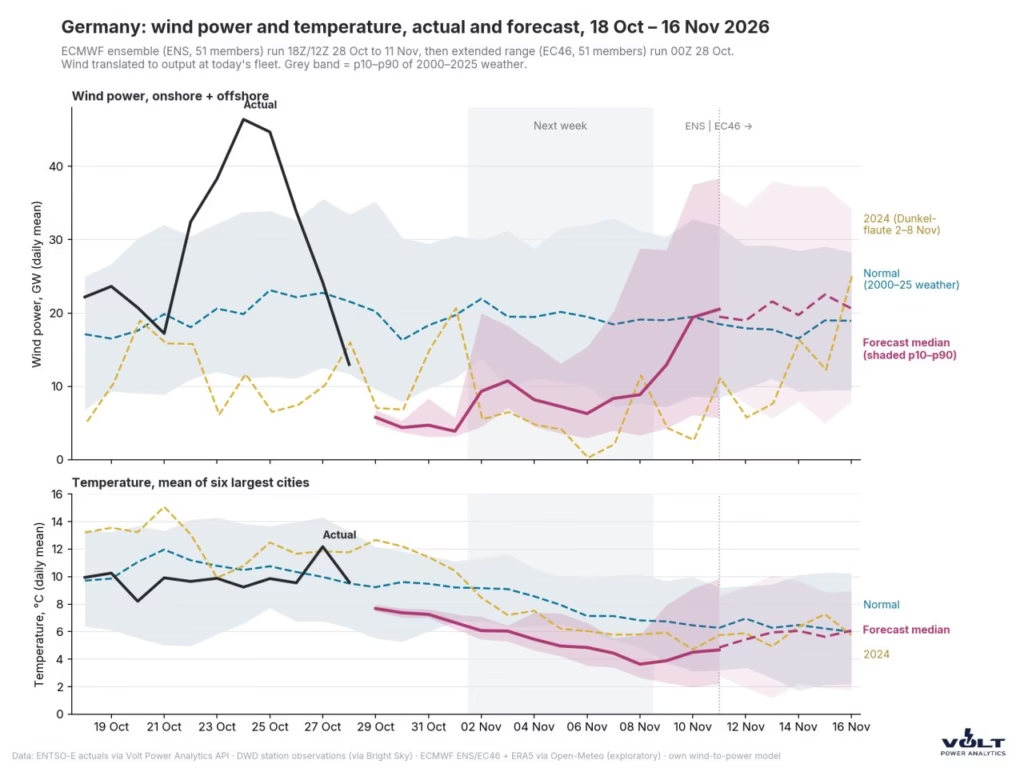
Last Sunday, German wind production averaged around 45 GW.
For the coming weekend, the ECMWF ensemble predicts just 4–5 GW, compared with a normal level of around 20 GW for this time of year.
During the Dunkelflaute at the beginning of November 2024, German wind generation averaged around 5 GW for an entire week.
For next week, the ensemble median is around 10 GW — approximately half of normal — while temperatures are forecast to be around 3°C below normal.
So, the wind forecast for next week is less extreme than during the 2024 event, but temperatures are colder.
The Market Is Pricing This In
The German baseload contract for 2–8 November has increased from around €175/MWh in early October to €260/MWh.
The following weeks are trading at around €229/MWh and €214/MWh as the wind forecast improves again.
This suggests the market is pricing this particular low-wind episode rather than a sustained shift across the entire forward curve.
Neighbouring Markets Are Affected Too
Neighbouring countries are also affected, but in different ways.
Southern Sweden, SE4, and Denmark moved from around €8/MWh and €12/MWh respectively on Sunday to approximately €300/MWh today.
SE4’s contract for next week has doubled since early October, while Denmark’s has increased by around 70%.
Norway’s hydropower acts as a buffer. NO2 remained above Germany during the windy weekend at €58/MWh and is around €183/MWh today.
Austria and Switzerland were already expensive because of low hydro reservoir levels and are now trading above €300/MWh.